
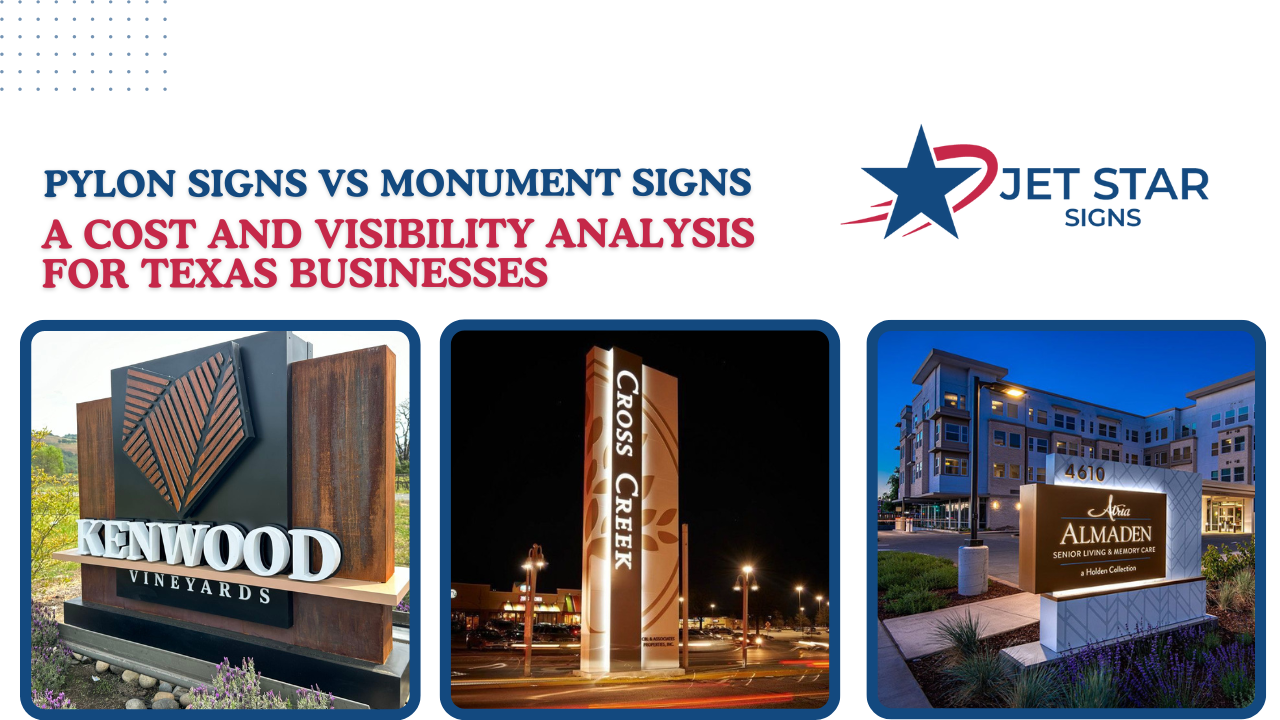
Driving through the sprawling commercial landscapes of Texas, from the busy corridors of Houston to the growing suburbs of Dallas, you’ll see two dominant types of freestanding signs vying for your attention: the towering pylon signs and the grounded monument signs. If you’re a business owner making a crucial decision about your property’s signage, you’ve likely found yourself weighing these two very different options.
This isn’t just an aesthetic choice; it’s a strategic business decision with significant implications for your visibility, brand perception, and budget. Choosing correctly can maximize your return on investment for years to come, while the wrong choice can leave your business hidden in plain sight.
So, how do you decide? This analysis will break down the key differences between pylon signs and monument signs, specifically through the lenses of cost and visibility that matter most to Texas businesses.
The Titans of Texas Visibility: A Quick Introduction
Before we dive into the numbers and strategies, let’s clearly define our contenders.
What is a Pylon Sign?
Often called a “pole sign,” a pylon sign is a freestanding structure elevated high above the ground on one or more large poles or a solid base. These are the tall signs you see at shopping centers, alongside highways, and at multi-tenant business parks. They are engineered for one primary purpose: maximum visibility from a long distance.
What is a Monument Sign?
A monument sign is a low-profile, ground-level sign that is typically wider than it is tall. Built from durable materials like stone, brick, metal, or stucco, it has a substantial, permanent “monumental” feel. Its goal is to mark a property entrance with elegance and authority, often complying with stricter community aesthetic codes.
The Visibility Showdown: Which Sign Gets Seen?
This is the most critical factor for most businesses. Let’s see how they stack up.
The Case for Pylon Signs: Unbeatable Long-Distance Reach
In the vast, car-centric environment of Texas, the pylon sign is the undisputed champion of long-distance visibility.
- The Texas Factor: Our cities are built for cars. On high-speed roads like I-10 in Houston or I-35 in Austin, drivers need ample time to see a sign, process the information, and safely change lanes. A pylon sign, often standing 20 to 100 feet tall, rises above tree lines, other buildings, and traffic, providing that crucial early visibility.
- Ideal for Multi-Tenant Properties: If you’re a property manager for a shopping plaza or business park, a pylon sign is the most effective way to advertise all your tenants at once, making the property itself more attractive and easier to locate.
- Standing Out in a Crowd: In dense commercial areas, a tall pylon sign ensures your business isn’t obscured by the competition.
The Case for Monument Signs: Premium Curb Appeal & Proximity Impact
While not designed for miles-away visibility, monument signs excel in a different kind of visual appeal.
- The Texas Factor: Many upscale Texas developments, particularly in communities like The Woodlands or master-planned areas, have strict sign codes that favor a cleaner, more architectural look. Monument signs are often the required—and preferred—option.
- Creating a Sense of Arrival: A well-crafted monument sign at the entrance of an office park, medical facility, or apartment complex creates a powerful, professional first impression. It conveys stability, quality, and permanence.
- Perfect for Slower-Speed Traffic: If your business is on a feeder road, a frontage road, or in a pedestrian-friendly area, a monument sign is perfectly positioned to be read easily by people who are already close to your location.
The Cost Analysis: Breaking Down the Investment
Cost is often the deciding factor, and it’s more complex than just the initial price tag.
Upfront Costs: Fabrication & Installation
Generally speaking, a large, double-faced pylon sign will have a higher initial investment than a standard monument sign. Here’s why:
- Pylon Sign Costs: The price is driven by the need for a deep foundation, a tall, engineered steel structure, more complex electrical work for elevated lighting, and a potentially more involved installation process requiring cranes or bucket trucks.
- Monument Sign Costs: While they can be very sophisticated, the structure is typically simpler. Costs are primarily driven by the choice of premium materials like natural stone or intricate brickwork. A basic monument sign can be more affordable upfront than a large pylon sign.
Winner on Initial Cost: Monument Signs (for basic designs)
Long-Term Value & Maintenance
The initial cost is only part of the story. You must consider the long-term value.
- Durability: Both signs, when built by a quality sign manufacturer using durable materials, are designed to last. However, the elevated nature of a pylon sign exposes it to higher wind loads, which can lead to more wear and tear over decades.
- Maintenance: Maintaining a pylon sign can be more complex and costly. Changing bulbs or repairing elements requires specialized equipment and trained technicians for working at heights. Monument sign maintenance is generally more straightforward and less expensive.
Winner on Long-Term Maintenance: Monument Signs
Return on Investment (ROI)
This is the most important calculation. The right choice depends entirely on your business needs.
- Pylon Sign ROI: If your business relies on capturing drive-by traffic from a high-speed road, the ROI of a pylon sign is immense. The customers it brings in by making you visible will quickly justify the higher initial cost. Without it, you might be invisible to a huge portion of your potential market.
- Monument Sign ROI: If your business benefits from a premium image (e.g., a law firm, boutique hotel, or spa) or is located where a pylon sign isn’t allowed, the ROI comes from reinforcing your brand value and ensuring you make the right impression on clients who are already seeking you out.
Winner on ROI: It’s a Tie. The ROI winner is the sign that best matches your location and business model.
The Verdict: Which Sign is Right for Your Texas Business?
So, should you choose a pylon sign or a monument sign? Ask yourself these key questions:
- What is my primary goal? Distance visibility or premium curb appeal?
- What are the local sign codes? This is the most critical step. A reputable signage company will know the regulations for your specific city or HOA.
- What is my business type? A retail store on a highway needs a pylon. A professional office in a park needs a monument.
- What is my budget? Consider both the initial investment and the long-term maintenance.
The Texas Factor: Weather and Durability
Texas weather is no joke. From scorching sun to powerful storms, your sign must be built to last. Whether you choose a pylon sign or a monument sign, ensure your sign partner uses high-quality, weather-resistant materials and proper engineering. For a pylon sign, this means a robust internal structure. For a monument sign, it means materials that won’t fade or crack.
For more on ensuring your investment lasts, see our guide on professional sign repair and maintenance.
Still Unsure? Let’s Analyze Your Specific Location.
The team at Jet Star Signs are Texas sign experts. We understand the local landscape, regulations, and what it takes to make a business stand out. We’ll provide a clear, honest assessment of which sign type will deliver the best results for your unique situation.
Ready to make the best investment for your Texas business’s visibility? Contact Jet Star Signs today for a free, on-site consultation and detailed quote. Let’s build the sign that will help your business grow.